.png?width=80&height=80&name=Clove%20Dental%20White%20Small%20(28).png "Clove Dental White Small (28)")
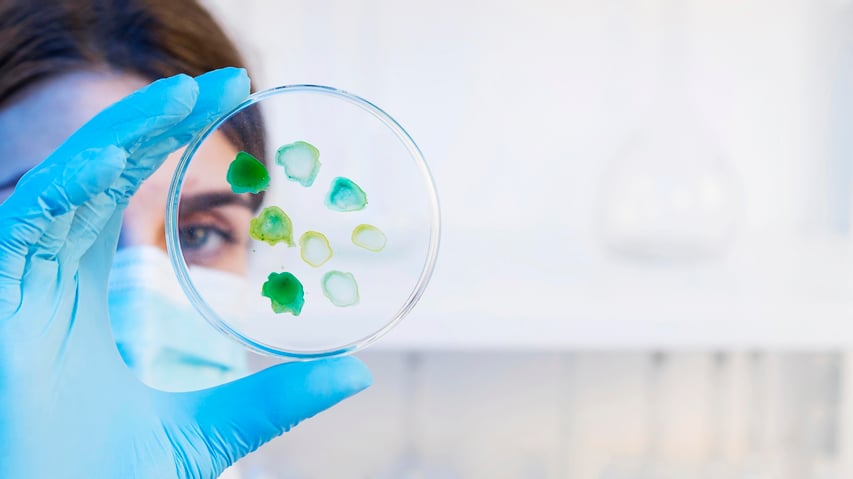
Dental plaque and biofilm are closely related terms. Plaque is a common name for the sticky layer of bacteria on teeth. Whereas, biofilm refers to the community of bacteria that attaches to tooth surfaces. Modern dentistry uses the term biofilm to better describe how bacteria grow, interact and affect gum health.
Key Takeaways
- Dental plaque is a layer of bacteria which is sticky in nature and is formed on teeth everyday.
- Oral biofilm is a scientific term that describes how bacteria organize and grow on your tooth surface.
- Biofilm does contribute to gum inflammation, cavities and periodontal disease if they are not removed regularly.
- Visiting our dentist in Ventura, California for routine care helps in keeping bacteria buildup under control.
When you leave your dentist’s office after a routine cleaning and everything feels fresh. But when you see the next day your perfectly clean feeling is already fading.
This happens when bacteria does not stay still. They quickly regroup and form a thin layer on the teeth. For years, dentists called this layer plaque. But today, many professionals use a much more precise term- Biofilm.
When you visit our dentist in Ventura, California, this concept will help you explain why brushing and flossing are important. At Clove Dental, our goal is not to remove plaque but to manage the bacterial biofilm that constantly forms on your teeth.
What Is a Dental Plaque?
Dental plaque is a sticky, colorless layer of bacteria that continuously forms on your teeth. It develops when the bacteria in your mouth gets mixed with food particles and saliva. If the plaque does not get removed by daily brushing and flossing then it can lead to-
- Tooth decay
- Gum inflammation
- Bad breath
- Tartar buildup
What Is Oral Biofilm?
Oral biofilm refers to a structured community of bacteria that attaches to surfaces in the mouth. Instead of floating freely, bacteria gather and create a protective matrix. This structure lets them to-
- Communicate with each other.
- Share nutrients.
- Become more resistant to removal.
Biofilm vs Plaque- Are They the Same Thing?
Plaque and biofilm are closely related to each other but are not exactly same.
|
Plaque |
Biofilm |
|
Common term used in everyday dental conversations |
Scientific term describing bacterial communities |
|
Refers to the sticky film on teeth |
Describes how bacteria organize and grow together |
|
Focuses on buildup |
Focuses on bacterial structure and behavior |
In layman terms, plaque is a type of biofilm that forms on teeth. In modern dentistry, the word biofilm is used to highlight the fiddly way bacteria interact in your mouth.
Why Modern Dentistry Is Shifting to the Term “Biofilm”
Dentistry is getting evolved as research reveals more about oral bacteria.
Using the term biofilm helps in explaining that bacteria are not just loose particles. Rather than they form organized systems that protect and let them grow over time.
Such understanding has transformed the way dentists approach prevention and treatment.
When a person visits a dentist in Ventura, California, they see technologies that are designed specifically to target biofilm. This includes modern airflow cleaning systems that remove bacterial layers much better.
Why Biofilm is Important for Gum Disease
Biofilm plays a major role in the development of gum disease. When biofilm gets accumulated along the gumline, it can trigger inflammation. Over the time, this might lead to-
- Gingivities
- Periodontitis
- Bone loss
The longer biofilm stays undisturbed, the more harmful bacteria it can obtain.
How Biofilm Is Removed During Professional Cleanings
Professional dental cleaning will help in removing biofilm which a person can’t eliminate at home. During a cleaning, a dentist in Ventura, California might use-
- Ultrasonic scaling tools.
- Hand instruments
- Polishing techniques
- Modern airflow technology.
All these tools will help you in removing bacterial buildup from tooth surface and surrounding area of your gum.
What This Means for Your Preventive Care Routine
Understanding biofilm will help you in getting why oral hygiene is important. To control biofilm buildup, patients must-
- Brush twice per day.
- Floss daily.
- Limit sugary foods and drinks.
- Schedule regular dental cleanings.
Such habits disrupt bacterial growth and help in keeping your teeth and gums healthy.

Final Thought
The slow shift from ‘plaque’ to ‘biofilm’ reflects a deeper understanding of how bacteria works in a mouth. While the terms are somewhat related, biofilms explains the hard way bacteria grow and contribute to dental disease.
FAQs
Is biofilm the same as plaque or calculus?
No. Plaque is a type of biofilm that forms on your teeth. Calculus, also called tartar, is a plaque that develops when plaque is not removed on a regular basis.
What is the difference between dental plaque and biofilm?
To be precise, a plaque is a sticky bacterial layer formed on your teeth. Whereas, biofilm describes the community of bacteria that forms and grows on the surface.
Does hydrogen peroxide get rid of biofilm?
Hydrogen peroxide can reduce bacteria, but it cannot fully remove biofilm. Brushing, flossing, and professional dental cleanings are still necessary for proper biofilm removal.