.png?width=80&height=80&name=Clove%20Dental%20White%20Small%20(28).png "Clove Dental White Small (28)")
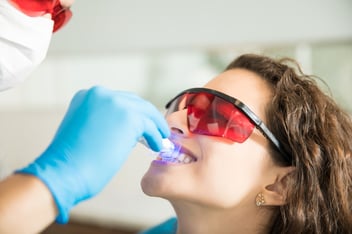
.jpg?width=6720&height=4480&name=female-patient-with-braces-has-dental-examination-dentist-office-woman-wearing-white-clothes%20(5).jpg) Mouth taping, placing tape over the lips during sleep to encourage nasal breathing is trending in wellness communities for claimed benefits around sleep quality, oral health, and even facial structure. Dentists have a more measured view. While nasal breathing is genuinely better for oral health than chronic mouth breathing, mouth taping addresses a symptom without diagnosing what is causing it.
Mouth taping, placing tape over the lips during sleep to encourage nasal breathing is trending in wellness communities for claimed benefits around sleep quality, oral health, and even facial structure. Dentists have a more measured view. While nasal breathing is genuinely better for oral health than chronic mouth breathing, mouth taping addresses a symptom without diagnosing what is causing it.
Key Takeaways
- Mouth taping is a wellness trend promoting nasal breathing during sleep but dentists are more focused on why a patient is mouth breathing than on whether they tape over it.
- Chronic mouth breathing causes dry mouth, gum inflammation, and accelerated plaque buildup, all detectable at a professional dental exam.
- Mouth taping is not appropriate for everyone and carries real risks for patients with undiagnosed sleep apnea or significant nasal obstruction.
- A routine teeth cleaning in Encino can reveal patterns consistent with chronic mouth breathing before the patient is even aware of the habit.
If you spend any time in wellness spaces online, you have seen the mouth taping content. Small strips of tape placed over the lips at night, promising better sleep, whiter teeth, stronger jaw structure, and improved focus. The claims vary wildly. The confidence behind them rarely does.
Dentists notice the trend too, mostly because patients have started asking about it. At Clove Dental, we do not dismiss the question. Nasal breathing is genuinely better for your mouth than breathing through it all night. The issue is not the destination. It is the logic used to get there, and whether a strip of tape is actually the right tool for the problem. Here is the more complete picture.
Why Did Mouth Taping Suddenly Become a Wellness Trend?
Mouth taping grew out of legitimate research on nasal breathing, specifically, the work of authors and researchers arguing that chronic mouth breathing is a modern health problem with broad consequences for sleep, facial development, and oral health. That underlying science has merit.
The trend took hold when that research filtered through social media into a simplified message: tape your mouth shut at night, breathe through your nose, improve everything.
The Question Dentists Ask First That Influencers Usually Don't
Before anything else, a dentist wants to know: why is this person's mouth breathing? The answer determines whether nasal breathing is simply an undeveloped habit or the result of a structural or medical issue that makes it difficult or impossible.
Common causes include chronic nasal congestion from allergies or sinusitis, a deviated septum, enlarged adenoids or tonsils, and critically obstructive sleep apnea. Sleep apnea causes the airway to collapse during sleep, triggering the body to compensate through mouth breathing.
At Clove Dental, patients disclosing a mouth taping habit are always asked about snoring, daytime fatigue, and whether a sleep study has ever been recommended because these questions matter before we weigh in on the tape.
Is Mouth Breathing Affecting Your Teeth and Gums?
Consistently, yes. When the mouth is open during sleep, saliva evaporates rapidly. Dry mouth overnight means bacteria multiply without the buffering, rinsing, and remineralizing that saliva performs all night in a healthy nasal breather.
The oral consequences are recognizable: gum inflammation that concentrates at the front teeth where airflow is greatest, accelerated plaque and tartar accumulation in the same zones, more frequent bad breath, and a higher rate of cavity formation at the gumline. Patients with this pattern often present thinking their brushing has gotten worse when the real variable is breathing.
Why Some Dentists Worry More About the Cause Than the Tape
The tape itself, for most healthy adults without sleep apnea, is probably low-risk. The concern is that it offers a behavioral fix that can delay the investigation of something that deserves one. A patient who tapes every night and sleeps better may not realize that the improvement came from incidentally positioning their jaw differently and that the undiagnosed sleep apnea is still there, now slightly less symptomatic but unresolved.
Patients who have had a sleep study ruling out sleep apnea, who know their nasal passage is clear, and who want to reinforce nasal breathing as a habit are in a different category.
What Your Teeth Cleaning in Encino Can Reveal About Chronic Mouth Breathing
One of the less-discussed values of routine professional care is pattern recognition. A teeth cleaning in Encino is not just plaque removal, it is a structured look at the oral environment by trained eyes who see hundreds of mouths a year.
Gum inflammation that clusters at the front teeth, unusual dryness of the palate, chronic bad breath despite good home hygiene, and specific tartar accumulation patterns are all consistent with chronic mouth breathing. At Clove Dental, findings like these prompt a conversation, not just a note in the chart because the cleaning is only useful if it leads somewhere.
Can Mouth Taping Help Some People? Yes, But Not for the Reasons Social Media Suggests
For patients who have been medically cleared, who are confirmed nasal breathers waking with dry mouth simply from positional mouth opening during sleep, gentle lip tape can help maintain lip closure and reduce morning dryness. In this specific and relatively narrow context, the intervention matches the problem.
What it will not do: straighten teeth, restructure the jaw, cure snoring, eliminate sleep apnea, or deliver the expansive list of benefits circulating online. Those claims exceed the evidence. But the core idea that nasal breathing is better for oral health and worth supporting is not wrong. It just needs to be arrived at correctly.

Conclusion
Mouth breathing matters for oral health. What to do about it depends entirely on why it is happening and that requires more than a wellness influencer's recommendation. It requires someone to look at your mouth, ask the right questions, and point you toward the right next step.
At Clove Dental, that is exactly what a teeth cleaning in Encino is designed to do.
FAQs
Is mouth taping safe to try at home?
For healthy adults without sleep apnea or significant nasal obstruction, the physical risk of gentle lip tape is low. However, mouth taping should not be attempted without first ruling out sleep apnea, as it can restrict a compensatory airway in patients with undiagnosed obstructive sleep apnea.
How do I know if I am a chronic mouth breather?
Common signs include waking with a dry or sore throat, bad breath despite good hygiene, chapped lips, and gum inflammation at the front teeth. A dental exam can identify oral patterns consistent with mouth breathing. A physician or ENT can assess the nasal and airway causes.
Will a teeth cleaning in Encino help if I have been mouth breathing?
Yes. Professional cleanings address the accelerated plaque and tartar buildup that mouth breathing causes, reduce gum inflammation, and give your dental team the opportunity to identify and discuss what is driving the pattern which is as important as the cleaning itself.
Should I see a doctor or a dentist first about mouth breathing?
Both can contribute valuable information. A dentist identifies oral consequences and patterns. A physician, ENT, or sleep specialist diagnoses structural or medical causes. If sleep disruption is involved, a sleep study is the most informative first step.
.jpg?width=352&name=old-man-sitting-dentist-s-office%20(4).jpg)