.png?width=80&height=80&name=Clove%20Dental%20White%20Small%20(28).png "Clove Dental White Small (28)")
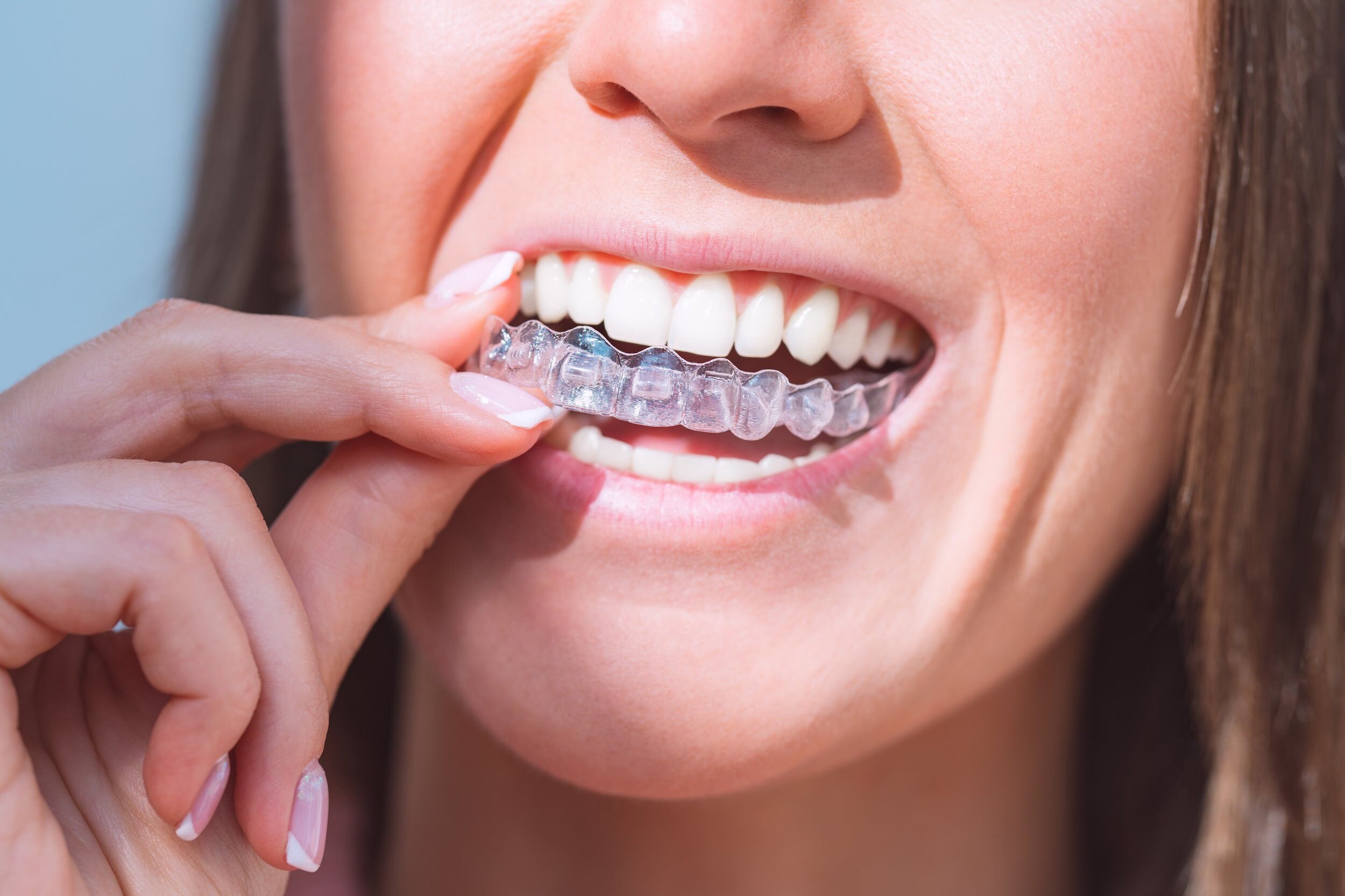
The dentist in Riverpark who provides Invisalign treatment can resolve a variety of alignment problems for adults or teens, from the minor crowding to more severe bite problems. Unlike traditional braces, Invisalign uses a series of clear, removable plastic braces which will gradually move teeth into position without metal brackets or wires. Before we suggest you get Invisalign treatment at Clove Dental in Riverpark, we will check your alignment, bite and goals to ensure it is the right alignment for you.
Key Takeaways
- A highly trained dentist in Riverpark can employ Invisalign to treat crowding, spacing, overbites, underbites and crossbites, basically much more than minor corrections.
- The popularity of clear braces over metal braces has made Invisalign a choice more and more popular among adults.
- One of Invisalign's most practical benefits is its removability; patients are able to enjoy their food, brush and floss their teeth without having to make any changes to their routine.
- Some cases require attachments, rubber bands or refinement trays that extend treatment. A thorough evaluation with your dentist in Riverpark ensures you go in with accurate expectations.
Have you been thinking about straightening your teeth but not quite ready to commit to metal braces? You're not alone and the options available today are genuinely different from what they were even ten years ago.
Invisalign has changed the conversation around orthodontic treatment for adults and teens. The clear aligner system offers a discreet, flexible path to a straighter smile that fits into real life without brackets, wires, or the self-consciousness that often comes with traditional braces.
At Clove Dental, our dentist in Riverpark team has helped patients at all stages of alignment correction achieve results they didn't think were possible without conventional orthodontics. Here's what Invisalign actually involves, what it can and can't do, and how we approach treatment planning to make sure outcomes match expectations.
Why Are So Many Adults Choosing Invisalign Now?
Orthodontic treatment used to feel like something for teenagers. The idea of a full set of metal brackets and wires at 30, 40, or 50 felt like too much visually, socially, and practically. Invisalign changed that calculation.
The numbers reflect the shift clearly. Adults now make up a significant and growing portion of Invisalign patients, and the trend has accelerated as the technology has improved and expanded to treat a wider range of cases.
A few reasons why adults are choosing Invisalign in particular-
- Professional environments- Clear aligners are nearly invisible in person and virtually undetectable in video meetings, making them far more compatible with professional and client-facing roles.
- Social comfort- Many adults are simply more self-conscious about visible orthodontic hardware than teenagers, who often normalize braces among their peers.
- Life stage flexibility- Adults tend to have more stable schedules and greater motivation to comply with treatment requirements, which leads to excellent results.
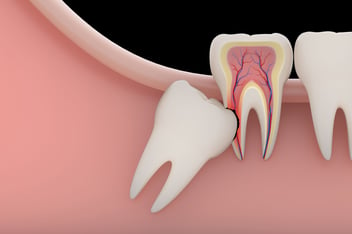
- Accumulated alignment changes- Teeth naturally shift with age, especially if wisdom teeth were never removed or retainers weren't worn consistently after prior orthodontic treatment
A consultation with a dentist in Riverpark at Clove Dental can quickly determine whether Invisalign is appropriate for your situation and give you a realistic timeline based on your specific alignment needs.
Can Invisalign Actually Fix More Than Minor Crooked Teeth?
One of the most persistent misconceptions about Invisalign is that it's only suitable for mild cases, a slightly crooked tooth here, a small gap there. The technology has advanced significantly beyond that scope.
Today's Invisalign system can address-
- Mild to moderate crowding- When teeth overlap or don't have enough room to sit in proper alignment.
- Spacing and gaps- Closing spaces between teeth, including larger gaps that were previously considered challenging for clear aligners.
- Overbite- When upper front teeth overlap too far over the lower front teeth vertically.
- Underbite- When lower teeth sit in front of upper teeth.
- Crossbite- When upper and lower teeth bite on the wrong side of each other.
- Open bite- When upper and lower front teeth don't make contact when the back teeth are closed.
The only way to know with certainty what Invisalign can achieve for your specific case is a proper evaluation including digital impressions or scans with an experienced dentist in Riverpark.
What Makes Invisalign Different From Traditional Braces?
Both Invisalign and traditional braces move teeth through the application of controlled, sustained pressure but the mechanism, experience and day-to-day reality of treatment are quite different.
Traditional braces-
- Brackets are bonded to teeth and connected by wires that are periodically tightened.
- Fixed in place cannot be removed by the patient.
- Require dietary restrictions (no hard, sticky, or chewy foods).
- Cleaning requires more effort, floss threaders, interdental brushes, and careful navigation around brackets.
- More visible, particularly metal brackets.
- Often more effective for severe cases or complex bite corrections.
Invisalign-
- Custom plastic aligners are worn over the teeth, changed every one to two weeks.
- Removable for eating, drinking, brushing, and flossing.
- No food restrictions.
- Standard brushing and flossing routine maintained throughout treatment.
- Virtually invisible in daily life.
- Requires strong patient discipline to achieve results. Aligners must be worn consistently.
The right choice between the two depends on the complexity of your case, your lifestyle and your personal priorities. For many adults seeking a dentist in Riverpark for alignment treatment, Invisalign offers a compelling combination of effectiveness and practicality as long as they understand and commit to the consistency it requires.
Why Some Patients Prefer Invisalign Even Beyond Appearance
The aesthetic advantage of clear aligners is the most commonly cited reason patients choose Invisalign but it's often not the only one. For many patients, the practical day-to-day differences are just as meaningful.
Oral hygiene maintenance- With traditional braces, cleaning around brackets and under wires requires extra tools and extra time. Food can become trapped in ways that increase the risk of plaque buildup, white spot formation and decay. Invisalign patients simply remove their aligners, brush and floss normally, then put them back in, maintaining their usual hygiene routine throughout treatment.
Comfort during treatment- Traditional braces involve periodic tightening appointments that can cause soreness for a day or two afterward. Aligners do cause some pressure when a new set is first placed, teeth are actively being moved but many patients find the overall experience more manageable, particularly after the first few days of each new tray.
Fewer dietary limitations- Traditional braces come with a list of foods to avoid, such as popcorn, hard candy, chewy bread, raw carrots, and anything else that could damage brackets or wires. With Invisalign, you simply remove the aligners before eating and enjoy whatever you like.
Predictability and visualization- Before Invisalign treatment begins, patients can often see a digital simulation of their projected tooth movement and final result. This level of transparency, knowing roughly what to expect and when, gives many patients a sense of involvement in their treatment that braces don't offer in the same way.
Why Invisalign Treatment Depends Heavily on Consistency
Aligners work by applying continuous, gentle pressure that gradually shifts teeth into new positions. That pressure only exists when the aligners are in the mouth. The Invisalign system is designed around 20 to 22 hours of daily wear, meaning a maximum of two to four hours out of the aligners for eating, drinking anything other than water, and oral hygiene.
Patients who consistently wear aligners for fewer hours than recommended will find that-
- Their teeth aren't moving as predicted by the time they're ready to advance to the next tray.
- Subsequent trays may not fit properly if the current set hasn't done its work.
- Treatment timelines extend, sometimes significantly.
- Refining trays and additional sets ordered to complete tooth movement become more likely.
Refinement trays are a normal part of some Invisalign treatments regardless of compliance, but inconsistent wear is the most preventable cause of extended treatment. When you meet with a dentist in Riverpark at Clove Dental before starting Invisalign, we have an honest conversation about what daily compliance looks like in practice because it matters more than most patients initially realize.
What Makes Some Invisalign Cases More Complicated Than Others?
Not every Invisalign treatment is equally straightforward and understanding the factors that add complexity helps set realistic expectations before you begin.
Attachments- Many Invisalign cases require small tooth-colored bumps called attachments to be bonded to certain teeth. These give the aligners more leverage to move specific teeth in specific directions that clear plastic alone can't achieve. Attachments are barely noticeable but do affect the aesthetic advantage slightly.
Rubber bands (elastics)- Some bite corrections, particularly overbites and underbites require rubber bands worn between upper and lower aligners to create the directional force needed to shift jaw position. This works like rubber bands in conventional braces, and also provides a compliance aspect to not just wearing the aligners.
Interproximal reduction (IPR)- If moderate crowding exists, there may not be enough space in the arch to align the teeth without creating some space. IPR is a soft technique that involves removing a small section of the enamel between certain teeth to provide the space required.
Refinement trays- At the end of the initial series of aligners, some patients need additional trays to complete fine-tuning that wasn't fully achieved in the original plan. Refinements are included in many Invisalign packages and are a normal part of achieving the best possible final result.
Knowing what your treatment specifically involves before you start is part of what makes the evaluation process at Clove Dental so important.
How Clove Dental Approaches Invisalign Treatment in Riverpark
As an experienced dentist in Riverpark, Clove Dental approaches Invisalign treatment as a clinical process, not a sales pitch. Before recommending Invisalign, we conduct a comprehensive evaluation of your teeth, bite, jaw relationship and oral health.
If we see signs of gum disease, active decay or other issues that need to be resolved before orthodontic treatment begins, we address those first. Moving teeth through compromised tissue or around untreated cavities creates complications that are entirely avoidable.
We use digital scanning technology to take impressions without messy impression material and create a precise 3D model of your teeth. From this model, we plan your treatment sequence, identify whether attachments or other components are needed and give you a realistic timeline and cost estimate before anything begins.
If Invisalign isn't the right fit for your case, we'll tell you directly and discuss what alternatives make more sense. Our goal is your best outcome, not the easiest recommendation.

Conclusion
Invisalign has made orthodontic treatment genuinely accessible and practical for adults and teens who wouldn't otherwise consider braces and the results, when treatment is well-planned and consistently followed through, are real and lasting.
The key is starting with an honest evaluation from a dentist in Riverpark who understands both what Invisalign can achieve and where its limits are. That conversation before the first tray is ever ordered is what makes the difference between a treatment that meets expectations and one that falls short.
FAQs
How long does Invisalign treatment typically take with a dentist in Riverpark?
Treatment length varies considerably based on the complexity of your case. Minor corrections may be completed in six to twelve months. More involved cases, including bite corrections or significant crowding, may take twelve to twenty-four months.
Can I drink coffee or tea with my Invisalign aligners?
It's recommended to remove aligners before consuming anything other than plain water. Hot beverages can warp the plastic and colored drinks like coffee and tea can stain the aligners and become visible during wear.
What happens after Invisalign treatment is complete?
After treatment, retainers are required to maintain your results. Teeth naturally want to shift back toward their original positions. Retainers prevent this.
Is Invisalign covered by dental insurance?
Some dental insurance plans include orthodontic benefits that apply to Invisalign the same way they would to traditional braces. Coverage varies by plan, and there is often a lifetime orthodontic maximum separate from your standard annual dental maximum.

.jpg?width=352&name=image(15).jpg)