.png?width=80&height=80&name=Clove%20Dental%20White%20Small%20(28).png "Clove Dental White Small (28)")
 Dental implant insurance coverage in California is a specific policy provision that pays a portion of your tooth replacement costs. While many PPO plans deny the surgical titanium post, they often cover up to 50% of the connected abutment and final custom crown under major restorative benefits. Medical literature supports the importance of compensation to dental practice satisfaction with PPOs [1] (Aseltine et al., 2007).
Cracking the Dental Billing Codes: Posts vs. Crowns
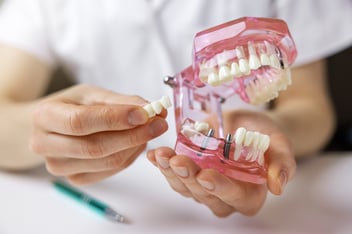
For the detail-oriented Up-and-Comer, understanding how dental offices bill your insurance is the secret to saving money. A dental implant is not just one piece; it consists of three distinct parts: the titanium post, the connecting abutment, and the final porcelain crown. Many patients read their insurance denial for the "implant" and give up. However, insurance companies use different billing codes for each piece. While your PPO provider might reject the surgical post (Code D6010) as an elective procedure, they will frequently cover up to 50% of the abutment (Code D6056) and the final crown (Code D6058) under your major restorative tier. Our team at Clove Dental itemizes these codes strategically to ensure you get every dollar your policy allows.

Does Insurance Cover Bone Grafting for Implants?
If you are a Wellness Enthusiast, you know that a strong foundation is vital for your body. The same is true for your jaw. If you have been missing a tooth for a long time, your jawbone naturally shrinks. You will likely need a bone graft to safely support a new implant. Whether insurance will pay for this extra step depends on the timing. If we place the bone graft on the exact same day a failing tooth is extracted, insurance often covers it as a necessary step to preserve the ridge. Notably, a clinical case study supported that, in this particular case, insurance coverage for bone grafting is recognized as non-reimbursable [2] (Huh, 2023). If you return months later for a graft, they may classify it as an elective implant preparation. We review your clinical timeline carefully to maximize your chances of graft coverage before surgery begins.
How to Trigger Medical Insurance for Dental Surgery
When you face a complex dental surgery, the standard $2,000 annual limit of a dental PPO feels restrictive. For the Practical Parent dealing with unexpected trauma, billing your major medical insurance is a powerful alternative. While medical insurance does not cover standard tooth decay, it steps in for structural or systemic issues. If your tooth loss was caused by a documented facial injury, a tumor removal, or if the missing teeth are actively causing severe sleep apnea, we can submit a medical claim. Medical policies rarely have low annual maximums, which can drastically reduce your out-of-pocket costs for full-mouth implant restorations.
Comparing Tooth Replacement Strategies
When insurance tries to dictate your care, you must weigh your options. Here is how an implant strategy compares to accepting a cheaper alternative.
|
Replacement Strategy |
Estimated Out-of-Pocket Cost |
Durability |
Maintenance Level |
|
Implant (Standard PPO Coverage) |
Moderate ($1,000 - $2,500) |
15+ Years to Lifetime |
Low (Brush and floss normally) |
|
Implant (Alternative Benefit Applied) |
Moderate to High ($1,500 - $3,000) |
15+ Years to Lifetime |
Low (Brush and floss normally) |
|
Traditional Bridge (Insurance Preferred) |
Lower Upfront ($500 - $1,500) |
7 - 10 Years |
High (Requires special flossers) |
|
Implant (Cash-Pay / In-House Plan) |
Fixed upfront discount |
15+ Years to Lifetime |
Low (Brush and floss normally) |
Upgrading Your Smile: Applying Denture Benefits to Fixed Implants
Many of our Long-Term Local patients currently wear a removable partial denture but dream of upgrading to a permanent implant. If your insurance policy includes coverage for removable dentures, you have a distinct financial advantage. We can often leverage the "Alternative Benefit" clause in reverse. Your insurance agrees to pay the monetary value of a new partial denture. Instead of actually making you another removable device, we take that exact dollar amount and apply it directly as a credit toward your new dental implant. This strategy allows you to secure a modern, fixed solution using older, traditional coverage limits.
The December Stacking Strategy: Combining PPOs and Health Savings
The Preventive Planner knows that timing is everything when it comes to healthcare budgets. A standard dental implant takes about three to four months to fully heal. You can use this healing period to your advantage by splitting your treatment across two calendar years. First, we place the surgical titanium post in November or December, maxing out your current year’s dental benefits. When you return in January or February to receive your final crown, your insurance maximum has reset. We then combine these two insurance payouts with your pre-tax Flexible Spending Account (FSA) funds to cover the remaining balance, legally minimizing your personal costs.
FAQs
1. What is a missing tooth clause for dental implants?
A missing tooth clause is a rule written into many dental insurance contracts. It states that if you had a tooth extracted before your current insurance policy went into effect, the plan will not pay to replace it. Our billing team always checks your policy for this specific clause before starting treatment.
2. Does California Medi-Cal or Denti-Cal pay for dental implants?
In most standard cases, Denti-Cal does not cover dental implants for adults. The state program views implants as elective and typically only covers removable partial or full dentures. Exceptions are exceptionally rare and require extensive medical necessity documentation for severe facial trauma.
3. Can medical insurance cover my dental implant surgery?
Sometimes. While routine dental implants are billed to dental insurance, your major medical insurance might step in if your tooth loss was caused by a documented medical condition. This includes severe accidents, oral cancer removal, or specific congenital defects.
References
[1] Aseltine, R. H., Jr, Reisine, S., Schilling, E. A., & Kennedy, J. (2007). Dental practice satisfaction with preferred provider organizations. BMC health services research, 7, 184. https://doi.org/10.1186/1472-6963-7-184[2] Huh J. K. (2023). Establishment of a new health insurance procedure code for oral and maxillofacial bone graft in Republic of Korea. Journal of the Korean Association of Oral and Maxillofacial Surgeons, 49(4), 169–170. https://doi.org/10.5125/jkaoms.2023.49.4.169