.png?width=80&height=80&name=Clove%20Dental%20White%20Small%20(28).png "Clove Dental White Small (28)")
.jpg?width=626&height=417&name=image(769).jpg)
A dental crown covers the entire visible surface of a tooth, restoring its shape, strength and appearance when the remaining tooth structure can no longer function reliably on its own. Crowns are most commonly placed after a root canal, when a tooth has been significantly weakened by a large filling or crack or when decay has removed too much natural structure for a filling to provide adequate support.
Key Takeaways
- A crown is recommended when a tooth's remaining structure is insufficient for a filling to support reliably, not as a default treatment for any damaged tooth.
- Two teeth with similar-looking damage can need different types of crowns based on their location, bite forces, and cosmetic visibility.
- What makes a crown feel natural is precision of fit, appropriate material selection, and accurate bite calibration, not simply the crown being tooth-colored.
- The planning phase before crown placement, including impression accuracy, material choice and shade matching, determines most of the outcome before the final crown is ever bonded.
Have you been told you need a crown and found yourself with more questions than answers? Crowns are among the most common restorative procedures in dentistry, and also among the most commonly misunderstood, both in terms of what they do and why they're recommended when they are.
At Clove Dental, dental crowns in Ventura are planned and placed with specific attention to what each individual tooth needs: what material will perform best in that position, how the crown will interact with the surrounding bite and what the patient will actually experience day to day once the restoration is in place.

Can a Dental Crown Save a Tooth?
In many cases, yes, and this is the primary clinical role of a crown. When a tooth has lost so much of its original structure through decay, a previous large filling or fracture that a filling would leave insufficient support on either side of the restoration, a crown encases the entire tooth and distributes chewing forces across the whole restoration rather than against fragile remaining walls.
Without a crown in this situation, the thin walls of natural tooth structure remaining on either side of a large filling are at significant risk of fracturing under normal biting forces. A fracture that extends below the gumline often makes the tooth unrestorable, meaning extraction becomes the only option, followed by the cost and complexity of replacement. A crown placed before that fracture occurs prevents the outcome that would have required it anyway, but at a much greater cost.
What Actually Changes After a Crown Is Placed?
For a crown that fits correctly, the practical changes are minimal, and that's the goal. The tooth should feel like a tooth. It should respond to bite pressure in proportion to the surrounding teeth, not stand high or feel hollow. Temperature sensitivity that existed before the crown may persist briefly as the tooth adjusts, but shouldn't intensify or become a new symptom.
Patients who receive a crown and feel it immediately are experiencing the most common post-placement issue: high occlusion. If the crown sits even fractions of a millimeter higher than the surrounding teeth, every bite contact through that tooth is amplified. This is correctable with a minor adjustment at the same appointment or a follow-up visit, it isn't a sign the crown is wrong, just that bite verification requires fine-tuning.
What Makes One Crown Feel Natural While Another Doesn't?
The difference between a crown that looks and feels like a natural tooth and one that stands out or feels wrong usually traces back to decisions made before the final crown was bonded.
Impression or scan accuracy- The crown is fabricated from a model of the prepared tooth. If the model doesn't capture the preparation margin with precision, whether from an inaccurate physical impression or a poorly captured digital scan, the crown won't fit precisely against the tooth, leaving a marginal gap or requiring excessive adjustment that changes the bite geometry.
Material translucency- Natural enamel is partially translucent, light passes through it rather than reflecting entirely off the surface. A crown material that's uniformly opaque reads as artificial under natural light.
Bite calibration- How the crown contacts opposing teeth when the patient bites down determines whether the tooth feels like it belongs in the bite or stands apart from it. Precise bite calibration, checking contact in multiple excursions, not just central occlusion, produces a crown that the patient stops thinking about quickly because it functions without drawing attention to itself.
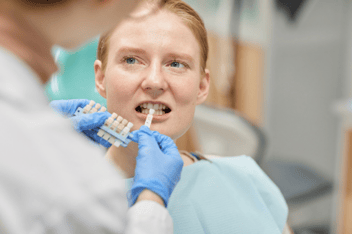
Shade matching- The shade of a crown relative to surrounding teeth involves more than a color chip match. Enamel varies in opacity and translucency from the gumline to the incisal edge.
How Dentists Plan a Crown That Protects Your Smile for Years
Crown placement at Clove Dental follows a process that begins before any preparation happens. For each crown case, we evaluate the occlusal load the tooth will carry, the cosmetic context of its position in the smile, the health of the surrounding gum tissue, and whether any preparatory work, existing filling removal, gum tissue evaluation, bite analysis, should happen before the preparation appointment.
The preparation appointment includes accurate capture of the prepared tooth surface for fabrication, either through digital scanning or physical impression, depending on what the specific case requires. Shade is taken under appropriate lighting with consideration for the surrounding teeth. A temporary crown is placed while the final restoration is fabricated, designed to approximate the planned final shape and allow the patient to identify any concerns before the permanent crown is bonded.
Conclusion
A well-planned and well-placed crown protects a tooth that would otherwise be lost, restores function that had been compromised, and does so in a way that the patient stops noticing because it simply works. The decisions that determine that outcome, material, fit, shade, bite calibration, happen before and during placement, not after the fact.
At Clove Dental, dental crowns in Ventura are planned around what each individual tooth specifically requires. Book your consultation at clovedds.com and let us explain exactly what your tooth needs and why.
FAQs
Can a crowned tooth get a cavity?
The crown material itself doesn't decay, but the natural tooth at the crown margin can. This is why hygiene at the gumline around a crown, specifically brushing at and slightly below the margin and flossing into the sulcus, matters as much as it does around natural teeth.
Is a same-day crown as good as a lab-fabricated crown?
For most cases, yes, in-office CAD/CAM milling from a digital scan produces a crown with fit and material quality comparable to a lab-fabricated restoration. Certain complex cases, particularly those requiring extensive cosmetic matching in visible smile areas, may benefit from the additional customization options available through a dental laboratory and a skilled ceramist.
Do I need a crown after a root canal?
For back teeth, molars and premolars, almost always yes. These teeth bear the greatest chewing forces, and the root canal procedure removes pulp tissue that previously maintained moisture in the tooth.