.png?width=80&height=80&name=Clove%20Dental%20White%20Small%20(28).png "Clove Dental White Small (28)")
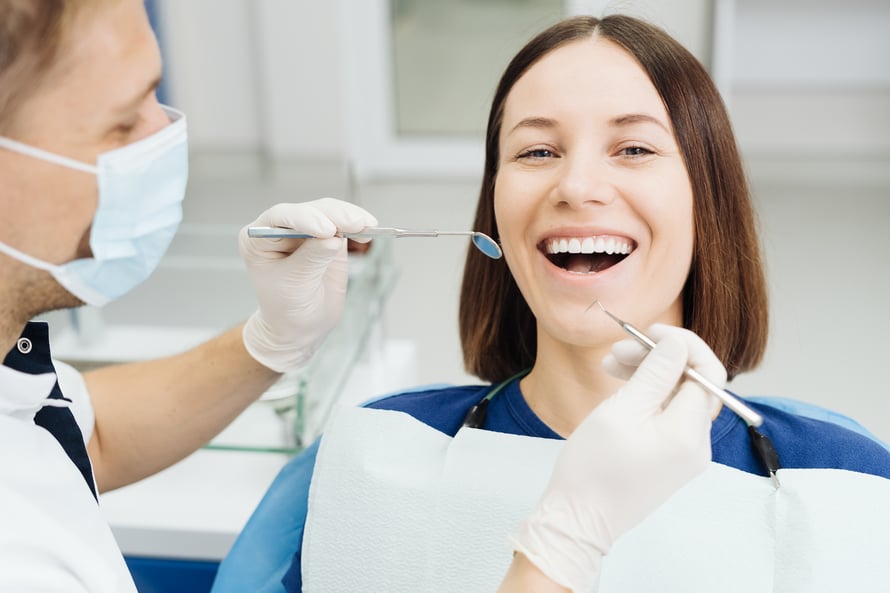
Recurring cavities in the same location usually signal something brushing alone can't fix a structural groove too deep to clean, a failing old filling with a gap at the margin, a flossing blind spot between teeth, or a saliva chemistry that makes certain areas more decay-prone than others. Professional teeth cleaning in Sherman Oaks, combined with a personalized cavity risk assessment, can identify exactly why certain spots keep breaking down and what needs to change to stop the pattern.
Key Takeaways
- Cavities recurring at the same site will almost always have a structural or biological origin, and are not corrected by brushing.
- The most common repeat cavity sites are deep grooves on molars, tight contact points between teeth and old filling margins.
- Brushing is not the only factor that determines the rate of decay; the chemistry of your saliva, your diet and when you eat it, and whether you breathe through your mouth or nose also play a role.
- Cavities between teeth are nearly impossible to detect without X-rays and are often missed until they've grown significantly.
- Regular professional teeth cleaning in Sherman Oaks with cavity risk mapping can identify vulnerable areas before they break down again.
You brush twice a day. Maybe you floss. You use a decent toothpaste. And yet, at your next dental appointment, there's another cavity. In almost the same place as the last one.
It's frustrating, and it raises a fair question: if you're doing everything right, why does it keep happening?
At Clove Dental, this is one of the most common conversations we have with patients. The answer is almost never "you're not brushing well enough." More often, it comes down to anatomy, biology, and blind spots in even the most committed oral hygiene routine. Understanding why recurring cavities happen and where teeth cleaning in Sherman Oaks fits into the solution can change the trajectory of your dental health entirely.
Why Do I Keep Getting Cavities in the Same Spot?
When a cavity forms once in a specific location, it's a signal. When it forms there twice, it's a pattern and patterns have causes.
The most common reason cavities return to the same spot is that the underlying condition that allowed the first cavity to form was never fully addressed. This could be a structural feature of the tooth itself, a gap in your cleaning routine that consistently misses that surface or a localized environment in your mouth where bacteria thrive more aggressively.
Think of it like a leaky pipe. Patching the water damage on the ceiling fixes the symptom. But if the pipe itself isn't repaired, the ceiling will leak again. Filling a cavity treats the damage but if the reason that spot keeps accumulating bacteria and acid isn't identified and corrected, another cavity is simply a matter of time.
Can You Brush Properly and Still Get Cavities?
Yes and this is important to understand, because many patients assume cavities are always a hygiene failure.
Brushing removes soft plaque from the surfaces your toothbrush can physically reach. That's a significant portion of your tooth surface but not all of it. There are areas of every mouth where a standard toothbrush simply cannot do its job effectively, regardless of technique or frequency-
- Between teeth, no toothbrush reaches these contact points.
- The bottom of deep grooves in molars' bristles often can't penetrate far enough.
- Under the gumline, brushing cleans to approximately 1mm below the gum margin, but bacteria live deeper.
- Around existing restorations, old fillings, crowns, and bonding create microscopic edges where plaque accumulates differently.
If your recurring cavities fall into any of these zones, brushing more or harder won't solve the problem. Professional teeth cleaning in Sherman Oaks combined with a targeted hygiene plan is what actually moves the needle.
Why Certain Teeth Are Much Harder to Keep Clean
Not all teeth are created equal when it comes to decay risk. Your back molars are dramatically more vulnerable than your front teeth and there are specific anatomical reasons for that.
Molars have deep pits and fissures on their chewing surfaces. These grooves are part of the tooth's natural structure, designed for grinding food. But they're also narrow enough that toothbrush bristles can't reach the bottom and that's exactly where bacteria and food particles settle.
Wisdom teeth, when present, create additional challenges. They're positioned at the very back of the mouth where toothbrush access is limited, and they often sit at angles that create tight spaces against the second molars, prime territory for repeat decay.
Teeth that are rotated, crowded, or misaligned also accumulate plaque more readily because they create overlapping surfaces and tight contacts that are harder to clean consistently. This is one reason orthodontic treatment can have a meaningful impact on long-term cavity risk, not just aesthetics.
Why Dentists in Sherman Oaks Often See Repeat Decay Around Old Fillings
Secondary decay, also called recurrent caries, is one of the most common findings in adult dental exams, and it almost always appears around the edges of existing restorations.
Here's why: every filling, crown, or bonded restoration has a margin, the point where the dental material meets the natural tooth. Over time, that margin can micro-gap. Temperature changes, biting forces, and natural material wear all contribute. As the micro-gap develops, bacteria invade and start to erode the tooth structure below, where it does not show on the surface until it has advanced.
This is why teeth cleaning in Sherman Oaks appointments that include thorough X-rays and margin checks around existing restorations catch these problems far earlier than symptoms alone would indicate.
Could Your “Healthy” Routine Actually Be Missing Something?
Many patients are doing most things right and still missing one or two factors that make a disproportionate difference in their cavity risk.
Flossing inconsistency is the most common gap. Even patients who floss regularly tend to skip certain spots, usually the back molars, or teeth that are tight and uncomfortable to floss. Those are often the exact spots where cavities keep appearing.
The timing of brushing also matters more than most people realize. Brushing before breakfast instead of after means acid from food and drink sits on your teeth for hours without being disturbed. Brushing immediately after acidic foods or drinks can actually worsen enamel erosion temporarily. Ideally, you'd wait 30 minutes.
Dry mouth caused by medications, mouth breathing, or simply not drinking enough water reduces saliva flow. Saliva is your mouth's natural defense against acid and bacteria. Without adequate saliva, decay forms faster and more aggressively, regardless of how well you brush.
Snacking frequency is another underestimated factor. Every time you eat or drink something other than water, your mouth enters an acid state for approximately 20–40 minutes. Three meals a day means roughly an hour of acid exposure. Frequent snacking can mean your mouth is in acid mode for the majority of the day.
Why Some Cavities Start Between Teeth Where You Can’t See Them
Interproximal cavities that form between two teeth are among the most commonly missed early-stage dental problems. They don't show up visually, they rarely cause symptoms until they've grown substantially, and they can only be reliably detected on bitewing X-rays.
These cavities begin on the side surface of a tooth, right at the contact point where two teeth touch. Plaque accumulates in that narrow space, acid builds up, and enamel starts to break down. By the time a patient feels any sensitivity or notices anything visually, the cavity has often progressed into the dentin, the softer inner layer of the tooth.
If you keep getting cavities between the same two teeth, the cause is almost always insufficient flossing at that specific contact because it's tight, uncomfortable, or awkward to reach. A water flosser, an interdental brush, or a different flossing technique can sometimes address it. In other cases, a tight contact may need to be professionally adjusted to allow better cleaning access.
What Happens When Cavities Repeatedly Form in the Same Tooth
A tooth that has been filled multiple times faces increasing structural risk with each restoration. Every time a cavity is treated, some natural tooth structure is removed to place the filling. Over successive treatments, the walls of the tooth become thinner and more fragile.
At a certain point, when a filling covers more than half the tooth's surface area, the tooth can no longer support another filling safely. The next step becomes a crown, which covers the entire tooth and distributes biting force more evenly.
Stopping the cycle early, through better risk mapping and professional teeth cleaning in Sherman Oaks, is always less costly, financially and structurally than managing it tooth by tooth over decades.
How Clove Dental Identifies High-Risk Cavity Areas Early
At Clove Dental, we approach every hygiene appointment as a diagnostic opportunity, not just a cleaning. Our process for patients with recurring decay includes-
- Comprehensive X-rays to detect interproximal cavities and secondary decay around existing restorations before they become visible
- Cavity risk assessment, a systematic evaluation of your saliva pH, diet patterns, dry mouth factors, and existing restoration condition
- Pit and fissure evaluation to identify deep grooves that may benefit from sealants before decay begins
- Personalized hygiene coaching focused specifically on the areas your current routine is missing, not generic advice, but targeted guidance based on what we actually observe in your mouth
- Fluoride application and remineralization options for patients with high acid exposure or early enamel softening
Our goal with every teeth cleaning in Sherman Oaks appointment is to send you home knowing more about your mouth than when you arrived and with a plan that actually addresses what's driving your cavity pattern.

Conclusion
Recurring cavities in the same spots are almost never about effort. They're about anatomy, biology, and blind spots that brushing alone can't reach. Understanding the real cause of your pattern is the first step toward actually breaking it.
At Clove Dental, we help patients move past the cycle of filling after filling by identifying what's actually driving their decay risk and building a prevention plan around it. If you've been frustrated by cavities that keep coming back, it's time for a different kind of appointment.
FAQs
Why do I keep getting cavities in the same tooth even after it's been filled?
When caries occur repeatedly in the same tooth, often it is because the tooth is structurally weak, has a deep groove, a leaking filling margin or a poorly cleaned contact point. Every filling added weakens the tooth, so it's important that the cause is found and corrected early.
Can good brushing habits prevent all cavities?
Not entirely. Brushing removes surface plaque on accessible surfaces of teeth, but can't remove plaque between teeth, deep grooves or under the margins of restoration. They are filled in with flossing, professional cleanings, and targeted preventive treatments.
How do dentists find cavities between teeth that you can't see?
Bitewing X-rays are the main method of diagnosis for interproximal cavities during routine dental check-ups. This is one of the main reasons why it is recommended to have regular X-rays even if you do not have any symptoms.
If I am prone to getting cavities, how should I seek a professional teeth cleaning in Sherman Oaks?
If a patient has a history of recurrent caries, they might need more frequent cleaning appointments every 3-4 months instead of the usual 6 months.