.png?width=80&height=80&name=Clove%20Dental%20White%20Small%20(28).png "Clove Dental White Small (28)")

Research, including 24 month clinical trials, shows that gum tissue volume and crestal bone height are better maintained with a concave abutment. The piece that connects the implant post to the crown, than with straight or convex abutments. If you are considering dental implants in Ventura, it is important to discuss abutment design with your provider. As it can play a big role in ensuring the long-term success of your dental implants.
Key Takeaways
- Concave abutments are those components of the implant connector that have a concave shape to decrease pressure on the surrounding gum tissue, which may help to maintain a larger volume of soft tissue and bone over time.
- In a 24-month clinical study, it was found that implants with concave abutments demonstrated significantly improved crestal bone and gingival tissue preservation over conventional abutments.
- The biological environment directly around the abutment significantly influences how an implant heals and how stable it remains years after placement.
- Implant design choices including abutment shape, can affect the long-term appearance of the restoration, particularly in the visible front teeth.
When most people think about dental implants, they picture the visible part, the crown, that looks and functions like a natural tooth. What happens underneath that crown, in the millimeters of tissue where the implant meets the gum, tends to be invisible and overlooked. But that junction is where some of the most clinically significant decisions about implant success are made.
A growing area of implant research is examining whether the shape of the abutment, the component that connects the implant post to the crown, influences how the surrounding tissue responds over time. And recent 24-month data is making a compelling case that it does.
At Clove Dental, we believe patients who are investing in dental implants in Ventura deserve to understand not just that implants work, but why some implants continue to look and function better than others over time. This is part of that conversation.
Why Do Some Dental Implants Stay Healthier Around the Gums Over Time?
Long-term implant success is not simply a function of whether the titanium post integrates with the bone, though that is the foundation. Osseointegration, the process by which the implant fuses with the jawbone, is now highly predictable with modern implant systems. Success rates above 95 percent over ten years are consistently reported in the literature.
What differentiates implants that continue to look and function beautifully at ten or twenty years from those that develop complications is often what happens in the soft tissue zone, the gums that surround and support the visible restoration.
What Part of a Dental Implant Connects to the Gums?
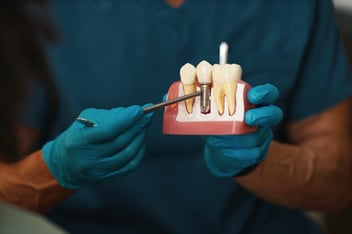
A dental implant system has three distinct components. The implant fixture is a titanium post inserted into the jaw bone and solidified with it during a period of months. The crown is the shape of the tooth that will be placed at the top and is clearly visible in the mouth. Between those two components sits the abutment, a connector piece that emerges through the gum tissue and provides the structural platform on which the crown is secured.
The abutment occupies what clinicians call the transmucosal zone, the area where the implant system passes through the soft tissue from bone to the oral environment. This zone is uniquely biologically active. The gum tissue immediately surrounding the abutment forms a cuff of soft tissue called the peri-implant mucosa, and the health, thickness, and stability of that cuff have a direct bearing on the long-term appearance and function of the implant.
What Is a “Concave Abutment” And Why Are Researchers Interested in It?
A conventional abutment is typically cylindrical or slightly convex in profile, wider at the coronal end near the crown and narrowing toward the implant connection. This design made engineering sense and was adopted early in implant dentistry without a significant study of what the profile geometry did to the surrounding tissue.
A concave abutment, by contrast, has an inward-curving profile in the transmucosal zone, narrower in the middle section where it passes through the gum tissue, then widening again to support the crown margin. The practical effect of this shape is that it reduces lateral pressure on the peri-implant mucosa from the inside out.
What Did the 24-Month Implant Study Actually Find?
Research comparing concave and conventional abutment designs over 24 months has produced findings that are difficult to dismiss. In controlled clinical studies, implants restored with concave abutments showed statistically significant advantages in two key measurements-
Crestal bone preservation- The height of bone immediately surrounding the implant neck was better maintained in the concave abutment group over the full study period. Bone resorption in the first one to two years after implant restoration is well-documented and has historically been accepted as a near-inevitable consequence of implant placement.
Peri-implant soft tissue volume- The thickness and height of gum tissue around the abutment was measurably greater in patients receiving concave designs. This translates directly to a more stable gum architecture around the implant and a lower risk of visible recession at the crown margin over time
Other studies reported shorter probing depths and fewer bleeding on probing in the concave group, which is a sign of better tissue health at the implant-abutment junction. At 24 months, these differences were clinically meaningful, not just statistically significant.
It is important to note that 24 months is a useful follow-up window but not the longest possible. Researchers continue to follow these patient cohorts and longer-term data will further clarify how durable these advantages are.
Why Gum and Bone Stability Matter for Dental Implants Long-Term
For patients considering dental implants in Ventura, this research matters for a practical reason: what happens in the first two years around an implant tends to predict what happens over the next decade.
Crestal bone loss that begins in year one tends to progress, not reverse. Gum recession that starts gradually can accelerate. Pockets that form between the gum and abutment surface become reservoirs for bacteria, increasing the risk of peri-implantitis, a destructive inflammatory condition that affects an estimated 20 percent or more of implant patients at some point and is one of the most challenging complications to manage.
Conversely, an implant that shows excellent tissue stability at 24 months is in a strong biological position. The soft tissue cuff has organized around the abutment, the bone margin is stable, and the immune environment around the implant is not under sustained challenge from a compromised seal.
Could Implant Design Affect How Natural an Implant Looks Over Time?
The aesthetic implications of abutment design are particularly significant for implants placed in the visible front teeth the smile zone. In this region, even small amounts of gum recession can create a noticeable visual discrepancy: a crown that appears longer than the adjacent natural teeth, or a dark abutment collar that becomes visible when the tissue recedes.
This is one of the most common reasons patients seek corrective treatment years after an otherwise successful implant procedure. The implant is functioning properly. The bone integration is intact. But the gum tissue has shifted enough to change the appearance of the smile in ways that are difficult to fully correct without additional soft tissue grafting procedures.
Can Better Implant Design Reduce Future Implant Complications?
The data suggests yes to a meaningful degree. Peri-implantitis, the inflammatory condition affecting gum and bone tissue around implants, does not arise randomly. It develops in environments where the biological seal between soft tissue and the abutment surface is compromised, where bacterial biofilm accumulates in pockets that form when tissue architecture degrades, and where the immune response around the implant is chronically activated.
A concave abutment design that maintains soft tissue thickness and reduces crestal bone resorption preserves a more favorable biological environment around the implant from the outset. A well-organized, thicker soft tissue cuff is better at forming and maintaining a bacterial seal. Stable bone margins reduce the pocket depth where bacteria establish themselves.
How Clove Dental Approaches Long-Term Implant Health in Ventura
At Clove Dental, we approach implant treatment with the understanding that placement is the beginning of a long-term relationship between the implant and the patient, not the endpoint of care. The decisions made during the planning and restoration phase carry consequences that unfold over years, and we take them seriously.
Our implant planning process includes a thorough evaluation of bone volume and density, soft tissue thickness and the emergence profile requirements for each specific tooth position. For cases where soft tissue preservation and aesthetic longevity are high priorities, particularly in the anterior smile zone, we discuss component selection as a meaningful part of treatment planning, not an afterthought.
We stay current with the clinical research on implant components, including the evolving evidence on abutment geometry and its effects on peri-implant tissue outcomes. When evidence is strong enough to influence clinical decisions, we act on it.
For patients considering dental implants in Ventura, we provide the kind of detailed, personalized planning that gives each implant the best possible foundation not just for the first year, but for the decades ahead.

Conclusion
The question of whether abutment design influences implant outcomes used to be largely theoretical. The 24-month evidence is beginning to give it a clinical answer and that answer is meaningful.
Concave abutments appear to preserve more gum tissue and more crestal bone than conventional designs. In a treatment where long-term tissue stability determines both function and appearance, that advantage is not cosmetic noise. It is a genuine clinical signal worth incorporating into how implants are planned and restored.
For patients considering dental implants in Ventura, the conversation about long-term success should extend beyond whether the titanium post integrates to what happens in the tissue surrounding it over the years. At Clove Dental, that is exactly the kind of conversation we are prepared to have.
FAQs
What is an abutment and why does its shape matter for dental implants?
An abutment is the connector component between the implant post in the jawbone and the crown visible in the mouth. Its shape determines how much pressure it exerts on the surrounding gum tissue.
How significant is crestal bone loss around implants, and can it be prevented?
Some degree of crestal bone remodeling after implant placement has traditionally been considered expected. Recent research, including studies on concave abutments, suggests that this resorption can be reduced through component design choices. Minimizing early bone loss is clinically important because it sets the trajectory for long-term tissue stability.
Does abutment design affect the appearance of my implant over time?
Yes, particularly for front teeth in the visible smile zone. Gum recession around an implant can make the crown appear longer than natural teeth or expose the abutment margin. Concave abutments reduce one of the mechanical contributors to that recession, supporting a more stable and natural-looking result over time.
What should I ask my provider when planning dental implants in Ventura?
Ask about the full implant system being used, how the abutment design is selected for your specific case, what the provider's approach is to monitoring tissue health after placement, and what long-term maintenance is recommended. A provider who engages thoroughly with these questions is one who is planning for your implant's lifetime, not just its placement.
.jpg?width=352&name=old-man-sitting-dentist-s-office%20(4).jpg)
.jpg?width=352&name=image(1277).jpg)