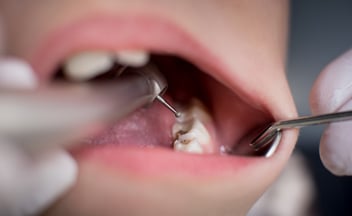
 Jaw pain when chewing without tooth sensitivity usually comes from temporomandibular joint (TMJ) inflammation, masseter muscle fatigue, or bite misalignment. Clinical literature supports that common TMD symptoms include pain in the chewing muscles and/or jaw joint [1] (NIH, 2023). This muscular strain can flare up when you eat tough foods and may require professional bite equilibration at Clove Dental, orthodontic alignment, or targeted muscle therapy for lasting relief.
Why Steak and Sourdough Bread Trigger Jaw Pain
When you eat soft foods, your jaw moves in a simple up-and-down motion. But when you tackle a thick crust of local Los Angeles sourdough or a chewy piece of steak, your jaw has to grind side to side. This lateral movement places intense strain on your temporomandibular joint (TMJ). If your teeth do not align perfectly, this side-to-side grinding stretches the delicate ligaments holding your joint together. The result is a sharp, exhausting ache in your cheeks before the meal is even over. While cutting your food into smaller pieces helps, correcting your bite alignment is the only way to enjoy these foods again without fear.
The Danger of Favoring One Side of Your Mouth
Medical evidence indicates that chronic unilateral temporomandibular disorders mainly affect the habitual chewing side [2] (Santana-Mora et al., 2013). Do you catch yourself always chewing your food on the right side? You might do this subconsciously because a tooth on the left side feels slightly sensitive or has an old, uneven filling. While this feels like a smart workaround, it damages your jaw. Your TMJ is designed to work as a synchronized pair. When you only chew on one side, you overwork that specific masseter muscle. This leads to asymmetrical muscle tension and severe, one-sided jaw pain. Our clinical team evaluates your whole mouth to fix the underlying tooth issue, allowing you to chew evenly and comfortably again.

Immediate Relief Strategies for Daytime Jaw Aches
If your jaw muscles flare up during a busy lunch meeting, you need relief fast. First, apply a warm, damp cloth to your cheeks for ten minutes. Unlike a sudden dental infection that calls for cold therapy, tired jaw muscles respond best to heat, which increases blood flow and eases spasms. Next, practice the "N-rest" position. Gently place the tip of your tongue on the roof of your mouth, right behind your upper front teeth, and let your lower jaw drop slightly. This parts your teeth and instantly takes the pressure off your TMJ.
Comparisons: Finding the Source of Your Chewing Pain
Understanding the difference between muscle fatigue and structural tooth damage helps you know exactly when to call the dentist.
|
Condition |
Primary Trigger |
Estimated Cost Impact |
Maintenance Level |
|
Masseter Muscle Fatigue (TMJ) |
Chewing tough or chewy foods for extended periods. |
Moderate (Bite adjustment or clear aligners). |
Low (Standard jaw resting techniques). |
|
Cracked Tooth Syndrome |
Sharp pain the moment you release your bite. |
Moderate to High (Requires a custom crown). |
Low (Treat like a natural tooth). |
|
Sleep Bruxism |
Waking up with a stiff jaw and morning headaches. |
Low (Custom night guard). |
Low (Wear the appliance nightly). |
How Your Desk Job and Posture Alter Your Bite
Many California professionals spend hours hunched over laptops or stuck in traffic on the 405. This "forward-head" posture physically pulls on the muscles in your neck and throat. Because these muscles connect directly to your jawline, poor posture actually drags your lower jaw backward. When your jaw sits too far back, your upper and lower teeth collide at the wrong angles every time you chew or swallow. Correcting your desk ergonomics and consciously sitting up straight can significantly reduce the mechanical stress placed on your bite during the workday.
Rebuilding Your Bite with Restorative Dentistry
Sometimes the source of your jaw fatigue is an old, flat dental crown or years of enamel wear. Your teeth naturally feature sharp peaks and deep valleys that lock together like puzzle pieces. When these chewing surfaces wear flat, your jaw has to slide around constantly to find a comfortable resting spot. This relentless sliding exhausts your facial muscles. At Clove Dental, we can replace flat, worn-out fillings or place custom porcelain crowns to rebuild the natural height and shape of your teeth. This gives your jaw a stable, locked-in place to land, instantly relaxing your overworked muscles.
FAQs
1. Why does my jaw get tired halfway through a meal?
When your bite is misaligned, your jaw joint has to shift unnaturally to chew your food. This forces the masseter muscle to exert extra effort. Just like running a marathon, the muscle eventually fatigues, causing a heavy, tired ache before you even finish your plate.
2. Can a misaligned bite cause TMJ pain on only one side of my face?
Yes. If you have a high filling or a crooked tooth on the left side of your mouth, you will naturally start chewing all your food on the right side to avoid the uneven spot. This one-sided chewing quickly overworks the joint on that side, causing localized TMJ pain.
3. Can Botox help with my clicking jaw when I eat?
Botox can help alleviate pain by temporarily relaxing an overactive masseter muscle, but it does not correct a misaligned bite or a displaced TMJ disk (the cause of the popping sound). You need a structural dental evaluation to correct the underlying cause of the joint dysfunction.
References
[1] NIH. (2023, March). TMD (temporomandibular disorders). Www.Nidcr.Nih.Gov. https://www.nidcr.nih.gov/health-info/tmd
[2] Santana-Mora, U., López-Cedrún, J., Mora, M. J., Otero, X. L., & Santana-Penín, U. (2013). Temporomandibular disorders: the habitual chewing side syndrome. PloS one, 8(4), e59980. https://doi.org/10.1371/journal.pone.0059980