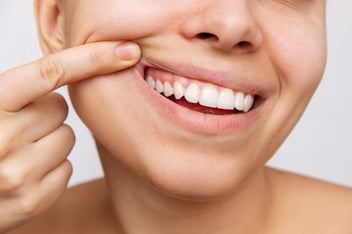
 Clinical evidence supports that Gingivitis is an inflammatory condition of the gingival tissue most commonly caused by bacterial infection [1] (Daley et al., 2026). However, advanced periodontal disease causes extreme pain when bacteria become trapped deep inside gum pockets, leading to sudden, throbbing periodontal abscesses, severe tissue inflammation, and active bone loss.
How Los Angeles Stress Triggers Sudden Gum Pain
High stress levels produce cortisol, a hormone that actively lowers your immune system. Medical evidence supports that those with higher stress exhibit a 15–36% greater incidence of periodontal problems [2] Macri et al., 2024). If you already have silent, painless gingivitis, a sudden spike in stress can strip away your body's natural defenses. Bacteria multiply rapidly when your immune system is suppressed. This sudden bacterial bloom turns mild inflammation into a painful, acute flare-up. We see this frequently in our busy California professionals at Clove Dental. By managing your oral health proactively, you help keep your gums resilient even during your most demanding work weeks.
Can You Reverse Silent Gingivitis at Home?
When you notice a little bleeding in the sink, your first instinct is probably to brush harder. Clinical literature supports that the main signs of gingivitis are red, swollen, and bleeding gums [3] (InformedHealth, 2023). The good news is that you can completely reverse early, painless gingivitis at home. Because the sticky plaque sits right on the surface of your teeth, upgrading to a soft-bristled electric toothbrush and using a daily water flosser will sweep the bacteria away. However, once the disease progresses into the painful, deep-pocket phase, your home tools simply cannot reach the infection. You cannot floss away a periodontal abscess. If your gums actively hurt, it means the bacteria have calcified into tartar deep below the gumline, requiring professional, sterile instruments to safely remove the blockage.

Comparisons: Gum Pain Profiles
Understanding the specific type of pain you are experiencing helps dictate the treatment you need.
|
Condition Profile |
Primary Pain Level |
Primary Cause |
Estimated Out-of-Pocket Cost |
Maintenance Level |
|
Early Gingivitis |
Painless (Mild bleeding only) |
Surface plaque buildup |
Low (Covered routine cleaning) |
Low (Daily brushing/flossing) |
|
Localized Impaction |
Moderate, sharp ache |
Trapped food (e.g., popcorn hull) |
Low (Single visit debridement) |
Low (Better flossing habits) |
|
Periodontal Abscess |
Severe, constant throbbing |
Deep trapped pocket infection |
Moderate to High (Requires drainage/antibiotics) |
High (Requires 3-month maintenance visits) |
|
Advanced Periodontitis |
Dull ache, loose teeth |
Chronic bone loss |
Moderate (Deep cleaning per quadrant) |
High (Requires 3-month maintenance visits) |
How We Detect Hidden Gum Disease Before It Hurts
You cannot diagnose advanced gum disease just by looking in your bathroom mirror. Because your pink gum tissue hides damage to your jawbone, your smile might look perfectly healthy even as a silent infection spreads. At Clove Dental, we do not wait for the pain to start. We use precise diagnostic tools to see what the naked eye misses. During your checkup, your hygienist gently measures your gum pocket depth with a specialized digital probe. Healthy pockets are shallow, usually one to three millimeters. If we discover pockets deeper than four millimeters, we use low-radiation digital X-rays to check for hidden bone loss. Catching these silent markers early lets us adjust your care plan right away.
The Systemic Link: What Aching Gums Do to Your Body
An active, painful gum infection is never just a localized mouth problem. When a periodontal abscess forms, the trapped bacteria enter your bloodstream through your inflamed gum tissue. When bacteremia occurs, a powerful systemic inflammatory response occurs that drives your heart and immune system into overdrive. Medical studies have linked long-term periodontal infections with an increased risk of cardiovascular problems and problems with blood sugar control. When you soothe your sore gums today, you are doing more than just stopping a toothache. You also reduce overall inflammation, which protects your long-term systemic health.
Gentle Relief: Easing Sore Gums Without the Dental Anxiety
Many patients are locked into a cycle of pain because they are afraid of the dental chair. You might worry that treating a painful gum infection will require an uncomfortable, invasive surgery. We want to put your mind at ease. Modern periodontal therapy at Clove Dental focuses strictly on your comfort. We do not use old-fashioned, aggressive scraping techniques. We anesthetize the area\ with fast-acting local anesthetics. And then we use ultrasonic instruments with quiet, warm water. These tools safely vibrate the tartar away with gentle sound waves and flush the painful bacteria out of your gum pockets.
FAQs
1. Can gum disease cause extreme pain all of a sudden?
Yes. While chronic gum disease is notoriously slow and painless, it can suddenly cause severe pain if a periodontal abscess forms. This happens when the opening of a deep gum pocket seals shut, trapping a highly active bacterial infection inside against the tooth root.
2. Is it normal for gingivitis to not hurt?
Absolutely. Gingivitis is classified as a "silent" condition. Because the inflammation affects only the top layer of soft tissue, it rarely triggers your pain receptors. Bleeding when you brush or floss is usually the only physical warning sign you will experience.
3. How can I tell if my gum pain is from an abscess or just brushing too hard?
If you brush too aggressively with a hard-bristled toothbrush, the pain usually feels like a superficial scrape or sting that fades quickly. An abscess causes a deep, persistent, throbbing pain that radiates through the jaw and is often accompanied by a visible, pimple-like bump on the gumline.
References
[1] Daley JO, Jain P. Gingivitis. [Updated 2026 Jun 7]. In: StatPearls [Internet]. Treasure Island (FL): StatPearls Publishing; 2026 Jan-. Available from: https://www.ncbi.nlm.nih.gov/books/NBK557422/
[2] Macrì, M., D'Albis, G., D'Albis, V., Antonacci, A., Abbinante, A., Stefanelli, R., Pegreffi, F., & Festa, F. (2024). Periodontal Health and Its Relationship with Psychological Stress: A Cross-Sectional Study. Journal of clinical medicine, 13(10), 2942. https://doi.org/10.3390/jcm13102942
[3] InformedHealth.org [Internet]. Cologne, Germany: Institute for Quality and Efficiency in Health Care (IQWiG); 2006-. Overview: Gingivitis and periodontitis. [Updated 2023 Aug 23]. Available from: https://www.ncbi.nlm.nih.gov/books/NBK279593/