.png?width=80&height=80&name=Clove%20Dental%20White%20Small%20(28).png "Clove Dental White Small (28)")
Both lasers and ultrasonics have the potential to improve root canal treatment outcomes by cleaning the canal system of the tooth better than conventional means alone and improved cleaning is directly related to less pain after the procedure and lower rates of re-infection. Lasers disinfect using concentrated light energy and ultrasonics use high frequency vibrations to flush debris from inaccessible areas.
Key Takeaways
- Both laser and ultrasonic technologies improve root canal outcomes by cleaning the canal system more completely, which reduces bacteria, inflammation and post-treatment pain.
- Lasers use concentrated light energy to disinfect the canal walls; ultrasonic instruments use high-frequency vibrations to flush debris from areas files cannot reach.
- Neither technology is a guaranteed pain eliminator the severity of the original infection and the skill of the endodontist remain the most important factors in recovery.
- Post-root canal discomfort is normal for a few days but should not be severe or prolonged; persistent pain is a signal to contact your dental provider.
- An experienced endodontist in Beverly Hills who combines advanced technology with precise technique offers patients the most complete, least disruptive path through root canal treatment.
Root canals have a reputation that far exceeds the reality of modern treatment. For most patients, the procedure itself is not the dramatic ordeal it is imagined to be. What concerns people more often is what comes after the days of soreness, sensitivity, and uncertainty about whether everything went the way it should.
That concern is legitimate. Post-root canal recovery varies widely between patients, and not entirely randomly. The technology used during treatment, the thoroughness of the cleaning, and the original severity of the infection all shape what recovery looks like. Two questions we hear regularly from patients researching their options are: does laser technology actually help? And how does it compare to ultrasonic methods?
At Clove Dental, we think patients deserve real answers not marketing language. So here is a clear-eyed look at both technologies, what the evidence says, and what it means if you are looking for an endodontist in Beverly Hills who uses the most effective tools available.
Why Do Some Patients Have More Pain After a Root Canal Than Others?
If you have ever compared recovery notes with someone who had a root canal and found your experiences were completely different, there is a reason for that. Post-root canal pain is not uniform; it is shaped by several variables that differ from patient to patient and tooth to tooth.
The most significant factors include-
- The severity and extent of the original infection- A tooth with an active abscess or long-standing infection involves significantly more bacterial load and inflammation than one treated early. More infection means more post-procedure inflammatory response.
- The complexity of the canal anatomy- Some teeth have simple, straight canals. Others have curved, narrow or branching canals that are harder to clean completely. Incomplete cleaning leaves bacteria behind, which extends recovery.
- The thoroughness of the disinfection- This is where technology plays a direct role. Better tools allow for a more complete removal of bacteria and debris which reduces the inflammatory trigger for pain.
- Individual healing response- Immune function, systemic health and even stress levels affect how quickly the tissues around a treated tooth settle down.
Understanding these variables matters because it reframes what "advanced technology" can and cannot do. It is not magic, it is precision.
What Causes Pain After a Root Canal?
Contrary to what many patients assume, pain after a root canal is not typically caused by the procedure itself. It is caused by the body's inflammatory response to what the procedure addressed and, in some cases, to residual bacteria or tissue debris that was not fully removed.
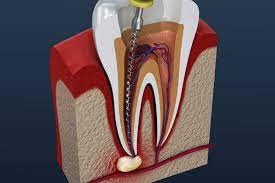
Here is the sequence: the tooth had an infection. The root canal removed the infected pulp and shaped the canal. But the periapical tissue, the tissue just beyond the tip of the root, was already inflamed before the procedure began. That inflammation does not switch off the moment the procedure ends. The body still needs to resolve it, and that resolution process produces discomfort for several days.
What Is Ultrasonic Root Canal Technology?
Ultrasonic instruments have been used in dentistry for decades, but their application in root canal treatment has grown significantly as the technology has improved. In endodontic procedures, ultrasonic devices generate high-frequency sound vibrations above 20,000 cycles per second that create a phenomenon called acoustic streaming.
In practical terms, this means that when the ultrasonic irrigating solution is activated in the canal, it moves with dramatically increased agitation, reaching into the curves, fins, and lateral canals that a hand or rotary file simply cannot access mechanically.
How Do Dental Lasers Work During Root Canal Treatment?
Dental lasers used in endodontic treatment operate on a different principle than ultrasonic instruments. Rather than physical agitation, lasers deliver concentrated light energy at specific wavelengths that are absorbed by bacterial cells, organic debris and the water in irrigating solutions.
The most commonly used systems in root canal treatment include erbium lasers and diode lasers. Erbium lasers are particularly effective at the wavelengths absorbed by water and hydroxyapatite, making them well-suited for debris removal and disinfection within the canal. Diode lasers are more commonly used for soft tissue procedures but have applications in canal disinfection as well.
Can Laser or Ultrasonic Technology Reduce Root Canal Pain?
The direct answer is: yes, both can and the mechanism is the same for both. More complete disinfection leaves fewer bacteria in the canal system after treatment. Fewer bacteria mean less sustained inflammation of the periapical tissue. Less inflammation means less post-treatment pain and a lower risk of the kind of persistent or recurrent symptoms that send patients back to the endodontist weeks later.
Studies on laser-assisted root canal treatment have shown statistically significant reductions in post-operative pain levels in some patient populations, particularly those treated for acute infections where bacterial load was high to begin with. Ultrasonic studies have shown similar trends.
Why Better Cleaning Inside the Tooth May Matter More Than Speed
Some technology in dentistry is primarily about efficiency, doing the same thing faster. The advanced disinfection technologies used in root canal treatment are not primarily about speed. They are about accessing places that have historically been beyond the reach of conventional instruments.
A root canal is not a single clean tube. It is a system with a main canal, lateral canals, anastomoses connecting branches, and apical deltas where the main canal divides near the root tip. Conventional files shape and clean the main canal effectively. They do not reach the rest.
Does Advanced Technology Replace the Skill of the Endodontist?
No and this point deserves emphasis. Technology in dentistry is a tool, not a substitute for clinical judgment and technical skill. The best ultrasonic system in the hands of a practitioner who does not understand canal anatomy or irrigation dynamics is not going to produce better outcomes than a skilled endodontist using well-executed conventional methods.
What technology does is expand the range of what a skilled practitioner can accomplish. An experienced endodontist in Beverly Hills who understands both the anatomy of the canal system and the physics of how laser and ultrasonic energy behave within it can use these tools with precision. Someone using the same equipment without that foundation cannot.
This is why, when patients research root canal treatment, the question should not be "does this office have lasers?" in isolation. It should be: does this provider have the clinical expertise to use advanced tools effectively, communicate clearly about what to expect, and handle complexity when it arises? Technology is a factor. It is not the whole picture.
Which Matters More for Recovery: The Technology or the Infection Severity?
Both matter and they interact. Infection severity sets the baseline: a tooth with a large abscess and extensive periapical inflammation is starting from a more difficult place, and recovery will take longer regardless of technology. That is simply the biology of tissue healing.
The practical implication: do not expect any technology to eliminate all post-root canal discomfort. Do expect that a more thoroughly disinfected canal gives your body a better starting point for healing and that a skilled endodontist in Beverly Hills choosing the right protocol for your specific situation is the most important single factor in your outcome.
How Clove Dental Approaches Modern Root Canal Care in Beverly Hills
At Clove Dental, our approach to root canal treatment is grounded in precision, transparency, and the understanding that a root canal is not just a procedure; it is a resolution. The goal is not simply to complete the treatment, but to give the tooth the best possible foundation for long-term survival and comfort.
We use advanced irrigation protocols that incorporate ultrasonic activation to ensure canal disinfection goes beyond what conventional approaches achieve. Our team evaluates each case individually because the right protocol for a straightforward first-time root canal is not the same as the right protocol for a retreatment case or a tooth with visible periapical pathology.
For patients seeking an endodontist in Beverly Hills who combines modern technique with genuine patient-centered care, we invite you to start that conversation with us.

Conclusion
Laser and ultrasonic technologies represent real, evidence-supported advances in root canal treatment, not marketing buzzwords. Both work by improving the thoroughness of canal disinfection, and more complete disinfection is the most direct path to less post-treatment pain and better long-term outcomes.
Neither technology works in isolation. Skill, case assessment, and clinical judgment are what determine how well these tools are used. And infection severity remains the most powerful predictor of how recovery unfolds; no technology changes that equation entirely.
What you can do is choose care that gives you the best possible starting point: a skilled, experienced endodontist in Beverly Hills who uses advanced techniques thoughtfully and communicates clearly about what to expect.
FAQs
Is laser root canal treatment significantly less painful than traditional methods?
Research suggests that laser-assisted disinfection can reduce post-operative pain, particularly in teeth with significant infection. The reduction is related to improved bacterial elimination which reduces the inflammatory response after treatment. Results vary by case severity and canal anatomy.
How is ultrasonic irrigation different from a regular rinse during a root canal?
Conventional irrigation delivers disinfecting solution by syringe; it flows into the canal but does not agitate significantly. Ultrasonic activation uses high-frequency vibrations to create acoustic streaming, which pushes the irrigant into lateral canals, fins, and branches that syringe delivery cannot reliably reach.
Does every root canal need laser or ultrasonic technology?
Not necessarily. Straightforward cases with simple anatomy and early-stage infection often respond well to conventional protocols. Advanced disinfection technologies add the most value in complex cases, retreatments or situations with higher bacterial load.
How long does post-root canal soreness last?
Mild to moderate soreness for two to five days after a root canal is normal as periapical tissues heal. Severe or worsening pain after the first few days or pain that persists beyond a week, should be evaluated by your endodontist.
What should I look for when choosing an endodontist in Beverly Hills?
Look for board certification or advanced endodontic training, experience with complex cases, transparent communication about the technologies and techniques used and a practice that takes time to explain your specific treatment plan. Technology matters, but clinical expertise and patient communication are equally important factors in outcomes.