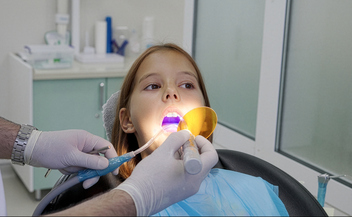
The alternate benefit clause is a dental insurance provision that limits PPO plans to paying only the cost of the least expensive treatment option. In 2026, many carriers use this clause to downgrade coverage for tooth-colored composite fillings on back molars, paying only the lower rate of a silver amalgam filling.
Decoding Your EOB: How to Spot the "LEAT" Trap
When your Explanation of Benefits (EOB) arrives in the mail, the paperwork often feels like it was written in another language. If your insurance downgraded your composite filling, you will likely see the acronym "LEAT" printed near the bottom of the page. This stands for the "Least Expensive Alternative Treatment" clause. Clinical literature supports that many third-party payers use the least expensive alternative treatment as a cost-containment measure [1] (ADA, 2025). Insurance carriers use this exact code to justify paying for a silver amalgam filling instead of the tooth-colored composite you actually received. They will state that the silver material restores the tooth's basic chewing function, which is technically true. However, they ignore the cosmetic and structural benefits of modern resin. You do not need to stress over translating these complicated billing codes. At Clove Dental, our administrative team reviews your specific policy details before you sit in the chair. We decode the LEAT trap early so you know exactly how your carrier handles back-molar restorations.
The Hidden Future Costs of Settling for Silver
When you have an out-of-pocket gap, the "Preventive Planner" might be tempted to accept a cheaper metal filling to save $40 today. Unfortunately, settling for silver often leads to expensive dental emergencies down the road. Your teeth live in a dynamic environment. Every time you sip hot Los Angeles coffee or drink a cold smoothie, a metal filling reacts. Silver naturally expands with heat and contracts with cold. Over several years, this constant flexing acts like a microscopic wedge inside your tooth. It slowly creates tiny hairline fractures in your healthy enamel. Eventually, the tooth can split, requiring a costly root canal and a custom porcelain crown. Composite resin does not react to temperature changes. It stays perfectly stable. Paying the minor upgrade fee for a white filling today acts as an insurance policy for your tooth, protecting you from high-cost structural failures in the future. Additionally, medical evidence supports that dental composites succeed in restorative dentistry because of their good esthetics and adequate durability [2] (Dionysopoulos et al., 2015).

Comparisons: The Financial Impact of Filling Downgrades
Understanding how your insurance calculates the math helps you plan your healthcare spending. Here is how standard 2026 PPO coverage compares across different tooth zones:
|
Restoration Zone |
Insurance Classification |
Estimated Carrier Payout |
Estimated Out-of-Pocket Impact |
Long-Term Maintenance Level |
|
Front Tooth (Composite) |
Basic Service (No Downgrade) |
80% of the composite fee |
Lowest (You pay the 20% copay) |
Low (Standard daily brushing) |
|
Back Molar (Composite) |
Downgraded via Alternate Benefit |
80% of the silver fee |
Moderate (You pay the 20% copay + the material differential) |
Low (Bonds securely to enamel) |
|
Back Molar (Silver/Amalgam) |
Basic Service (Least Expensive) |
80% of the silver fee |
Low (You pay the 20% copay) |
Moderate (Requires monitoring for metal expansion) |
Dual Insurance: Can a Second Plan Cover the Upgrade?
Many California families benefit from dual coverage, carrying one dental policy through their own employer and a second through their spouse. You might hope your secondary insurance will step in and pay the remaining balance for your tooth-colored filling. While dual coverage is a powerful tool, it requires careful navigation. The process is called Coordination of Benefits (COB). If your primary insurance downgrades your filling to a silver rate, your secondary insurance will review the claim. Some secondary plans feature a "non-duplication" clause, meaning they will also enforce the exact same downgrade. However, other premium plans will gladly pick up the remaining composite differential. You never have to figure out this complex insurance math alone. Our billing experts at Clove Dental submit your claims to both carriers at the same time, fighting to reduce your out-of-pocket costs to the absolute minimum.
How In-Network Status Protects Your Wallet from Upcharges
If your insurance downgrades your filling, where you choose to get your dental care completely changes your final bill. Visiting an out-of-network clinic for a white filling leaves you financially exposed. Out-of-network dentists can charge full retail market rates for the composite resin, meaning your gap payment could be hundreds of dollars. Choosing a trusted, in-network provider like Clove Dental protects your household budget. Because we are in-network with most major California PPO plans, we are legally bound by contracted fee schedules. Even if your insurance only pays the silver rate, they still regulate the maximum amount we can charge you for the composite upgrade. This pre-negotiated discount guarantees your out-of-pocket differential remains strictly capped, usually between $30 and $60 per tooth. You receive premium, modern materials without the fear of an inflated surprise bill.
Using Your FSA and HSA to Bridge the Cosmetic Gap
For the busy "Career Climber" or "Family CEO," managing healthcare expenses requires smart financial tactics. If your insurance plan downgrades your composite filling, you do not have to pull money out of your standard checking account to cover the difference. You can leverage your employer-sponsored health benefits. The IRS classifies the out-of-pocket upgrade from a silver filling to a composite filling as a qualified medical expense because the material directly treats active tooth decay. This means you can legally swipe your Flexible Spending Account (FSA) or Health Savings Account (HSA) debit card right at our front desk to pay the differential. By using these pre-tax dollars, you effectively give yourself a 20% to 30% discount based on your tax bracket. It is a seamless, budget-friendly way to secure the flawless, natural-looking smile you want.
FAQs
1. Can I appeal a composite filling downgrade in 2026?
Generally, no. An alternate benefit clause is a strict contractual rule written into the policy your employer purchased. Because the insurance company successfully paid for the "fix" based on their contract terms, appeals for material upgrades on back molars are almost always denied.
2. Why does my plan cover white fillings on my front teeth but not the back?
Insurance carriers define your front teeth as the "aesthetic zone." They acknowledge that placing a dark metal filling on a highly visible front tooth is unacceptable for your social and professional well-being. For back teeth, they base coverage strictly on chewing function, ignoring cosmetic appeal.
3. Will I know about the downgrade before my procedure at Clove Dental?
Yes. We hate surprise medical bills just as much as you do. Our treatment coordinators understand the exact billing codes and downgrade clauses used by major California insurance providers. We will show you the exact out-of-pocket difference before you ever sit in the dental chair.
References
[1] ADA. (2025). Least expensive alternative treatment clause. Ada.Org. https://www.ada.org/resources/practice/dental-insurance/least-expensive-alternative-treatment-clause
[2] Dionysopoulos, D., Papadopoulos, C., & Koliniotou-Koumpia, E. (2015). Effect of temperature, curing time, and filler composition on surface microhardness of composite resins. Journal of conservative dentistry : JCD, 18(2), 114–118. https://doi.org/10.4103/0972-0707.153071