.png?width=80&height=80&name=Clove%20Dental%20White%20Small%20(28).png "Clove Dental White Small (28)")
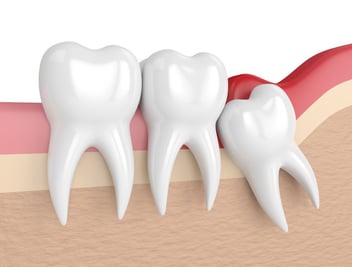
Not all wisdom teeth require extraction. Those that fully erupt in a functional position, cause no crowding or pain and can be kept clean may be monitored without removal. Wisdom teeth become candidates for removal when they're impacted (unable to fully erupt), causing recurring infections in the surrounding gum tissue, putting pressure on adjacent teeth or developing decay that can't be properly treated due to their position.
Key Takeaways
- Not every wisdom tooth needs to be extracted, position, eruption pattern and ability to keep the tooth clean determine whether removal is warranted.
- The most common reasons for removal are impaction, recurring pericoronitis, crowding and decay that can't be properly addressed.
- Recovery involves three to five days of significant discomfort, with full tissue healing taking several weeks most patients are surprised by how manageable it actually is.
- Delaying removal once a problem has been identified tends to make the procedure more complex as roots develop further and bone density around the tooth increases.
Are you wondering whether your wisdom teeth actually need to come out or whether you can simply leave them alone? It's a reasonable question and the honest answer is that it depends entirely on how your wisdom teeth have developed and whether they're causing or likely to cause problems.
At Clove Dental, wisdom teeth removal in Camarillo starts with an evaluation, not a blanket recommendation. Here's what goes into that decision, what recovery genuinely looks like and what to consider if you've been putting off having yours assessed.

Why Not Every Wisdom Tooth Needs to Be Removed
Wisdom teeth, formally called third molars, develop in the late teens and early twenties. In some patients, they erupt fully into a functional position, cause no crowding of the neighboring teeth and can be cleaned effectively with normal brushing and flossing. These wisdom teeth can reasonably be left in place and monitored over time.
The problem arises when wisdom teeth don't have adequate space to erupt properly. They may emerge only partially, remaining partially covered by gum tissue or become fully impacted, unable to break through the surface at all. Neither situation automatically requires immediate removal but both warrant monitoring and intervention when complications develop or become likely.
The Warning Signs That a Wisdom Tooth Is Becoming a Problem
A few specific symptoms suggest a wisdom tooth that's monitoring isn't the right approach anymore. Recurring pain or swelling at the back of the jaw, particularly pain that develops and then fades rather than resolving completely, is a sign of pericoronitis infection in the gum tissue surrounding a partially erupted wisdom tooth.
Jaw stiffness or difficulty opening fully, a bad taste in the back of the mouth that brushing doesn't resolve and pain that radiates toward the ear or surrounding teeth are also worth reporting. A wisdom tooth pushing against the adjacent second molar can cause damage to that tooth that isn't felt directly but shows up on X-ray, another reason evaluation matters even without obvious symptoms.
What Recovery Is Really Like And What Most Patients Are Surprised By
The reputation of wisdom tooth removal tends to run worse than the actual experience for most patients. With modern anesthetic and sedation options, the procedure itself is generally well-tolerated. The recovery period is where most people's experience diverges from their expectations.
Swelling peaks around 48 to 72 hours after the procedure and then gradually reduces. Discomfort is most significant in the first two to three days and manageable with appropriate pain relief. Soft foods for several days, limited mouth opening and avoiding straws and smoking are the main restrictions.
What surprises patients most frequently is that the actual discomfort is more manageable than they anticipated and that most of the difficulty is in the dietary and activity restrictions rather than pain itself.
Can You Delay Wisdom Tooth Removal? Here's What to Consider
If a wisdom tooth has been evaluated and is causing no symptoms and shows no immediate risk of causing problems, delaying removal may be reasonable with regular monitoring. Annual X-rays allow your dentist to track whether anything is changing.
If a problem has already been identified an infection has occurred, crowding is evident, decay has started to delay work against the patient in a few specific ways. Root development continues over time which generally makes extraction more involved and recovery more complex. Damage to an adjacent tooth from a poorly positioned wisdom tooth accumulates while the decision is being postponed.
What's the Best Time to Have Wisdom Teeth Evaluated?
Most dentists recommend an initial wisdom tooth evaluation in the late teenage years, around 17 to 19, when the teeth have developed enough to assess clearly but roots are still forming. Earlier removal at this stage when indicated is generally simpler, faster and associated with easier recovery than removal performed in the mid-twenties or later.
That said, adults who never had their wisdom teeth assessed can still benefit from evaluation. Some will find that their wisdom teeth are well-positioned and require no intervention. Others will find a problem that's been quietly developing and is now worth addressing.
Conclusion
The decision about wisdom teeth isn't a blanket one. Some patients genuinely don't need removal; others do and the sooner the evaluation happens, the more options remain available. What always makes sense is understanding where your wisdom teeth stand rather than assuming either that they're fine or that they inevitably have to come out.
At Clove Dental, wisdom teeth removal in Camarillo starts with an evaluation that gives you a clear picture of your specific situation. Book your assessment at clovedds.com and find out where your wisdom teeth actually stand.
FAQs
Do all wisdom teeth need to come out eventually?
No. Wisdom teeth that have fully erupted, are properly positioned and can be kept clean may remain indefinitely with regular monitoring. Only those causing problems or likely to cause them are candidates for removal.
How long does wisdom tooth removal take?
A single uncomplicated extraction takes 20 to 45 minutes. It is more time-consuming to remove more than one tooth or to treat impacted teeth in more complicated positions, which may require oral surgery instead of a regular tooth extraction.
What is dry socket and how do I avoid it?
Dry socket occurs when the blood clot protecting the empty socket is lost or dissolves before healing is complete, exposing the underlying bone. Avoiding straws, smoking and vigorous rinsing in the first few days after extraction significantly reduces the risk.
How soon after evaluation do wisdom teeth need to come out?
A tooth causing active infection may warrant prompt scheduling. A tooth being monitored for position may not need removal for months or longer or may never require it.
.jpg?width=352&name=image(1220).jpg)