.png?width=80&height=80&name=Clove%20Dental%20White%20Small%20(28).png "Clove Dental White Small (28)")
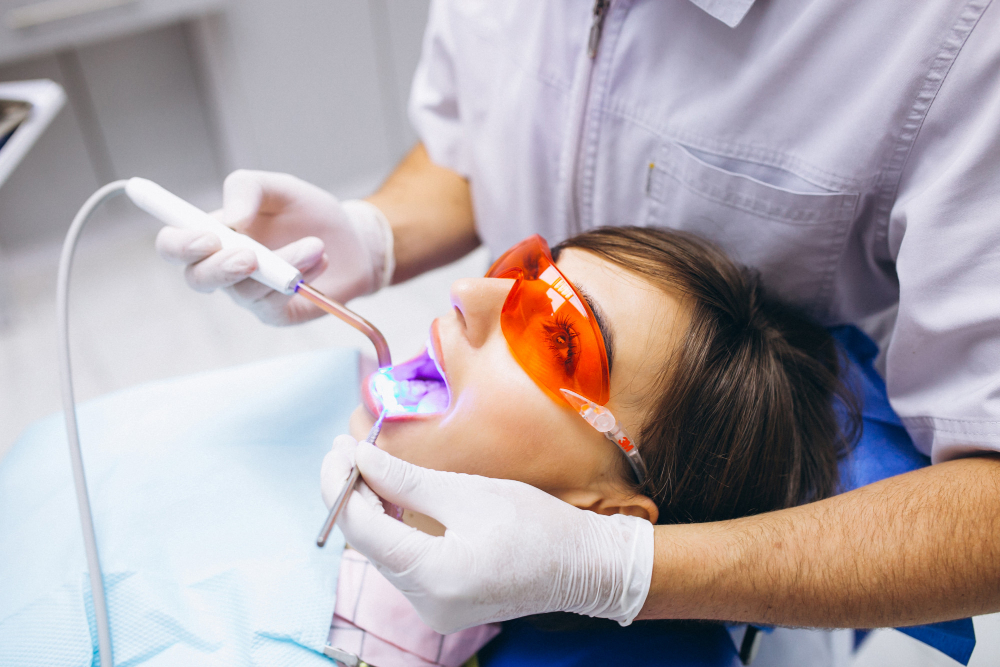
Laser dentistry uses concentrated light energy to treat specific dental conditions, including gum tissue reshaping, treatment of gum disease, cavity preparation in some cases and removal of soft tissue lesions. Lasers can reduce bleeding, minimize the need for sutures and allow some procedures to be completed with less anesthetic than traditional methods require.
Key Takeaways
- Dental lasers are used in specific procedures primarily soft tissue work, gum disease treatment and some cosmetic reshaping not as a universal replacement for conventional instruments.
- In appropriate applications, lasers reduce bleeding, minimize post-procedure discomfort and require less or no local anesthetic compared to traditional methods.
- The value of laser dentistry comes from choosing the right tool for the right procedure, not from using a laser whenever possible.
- Technology in dentistry should serve the patient experience and the clinical outcome laser dentistry is most valuable when it genuinely improves one or both.
Have you heard the phrase "laser dentistry" and wondered what it means and whether it means fewer drills, less discomfort or something more futuristic than the reality warrants? Laser dentistry is real, clinically meaningful in specific applications and also somewhat overhyped in the general conversation around it.
At Clove Dental, we use laser technology where it genuinely improves what we can do for patients not as a marketing feature or a blanket improvement on traditional methods. A dentist in Camarillo who uses lasers thoughtfully can explain exactly when and why a laser is being chosen and what it changes for the patient. Here's that honest explanation.

"Will You Still Need a Drill?" The First Question Most Patients Ask About Laser Dentistry
The expectation when patients hear "laser dentistry" is that the drill disappears entirely. In practice, the answer is: sometimes and it depends on what's being treated.
Dental lasers work by delivering concentrated light energy to tissue. Different wavelengths interact differently with different tissue types, some are optimized for soft tissue (gum and cheek tissue), some for hard tissue (enamel and dentin) and some for bacteria.
In hard tissue applications preparing a cavity for filling in enamel or dentin laser drills exist and are effective for certain cavity types, but they're slower than conventional drills, not appropriate for all locations or cavity sizes, and not universally more comfortable.
Five Situations Where Your Dentist Might Choose a Laser Instead of Traditional Instruments
Gum tissue reshaping (gingivectomy or crown lengthening)
When the gumline is uneven, covers too much of the tooth surface or needs to be adjusted before a restoration, laser reshaping can accomplish what a scalpel would do with less bleeding, no sutures in most cases and faster healing.
Treating gum disease pockets
Laser-assisted periodontal treatment can decontaminate pockets, remove diseased tissue from inside the pocket wall and promote reattachment of healthy tissue. This is a complement to scaling and root planing in moderate to advanced gum disease, not a replacement for it.
Removal of soft tissue lesions
Small fibrous growths, benign tissue abnormalities or ulcers that need biopsy can be addressed with a dental laser with minimal bleeding and without sutures. The tissue sample for pathology is preserved and the recovery is faster than conventional excision.
Treatment of aphthous ulcers (canker sores)
Low-level laser therapy can reduce the pain of a canker sore and accelerate healing, one of the more patient-pleasing applications because the discomfort reduction is immediate.
Cavity preparation in select cases
Laser cavity preparation is most practical for small, early-stage cavities in specific tooth locations. For patients with drill-related anxiety, this can be a meaningful option in appropriate cases.
What Changes for the Patient When a Laser Is Used?
The patient experience in a laser procedure varies depending on what's being done. In soft tissue applications, the most commonly reported differences are less bleeding during the procedure, less swelling and discomfort in the days following and the absence of sutures that would otherwise need to be placed or removed.
For many soft tissue laser procedures, local anesthetic either isn't needed or is needed in a smaller amount than the equivalent conventional procedure would require. This changes the experience of the appointment significantly for patients who have anxiety about needles or about the numbness that follows local anesthetic.
Laser Dentistry Is Advanced Technology But It Isn't Always the Best Option
This is where an honest assessment of laser dentistry diverges from the marketing version. Not every procedure is improved by using a laser. Not every patient benefits equally. And a dental practice that uses a laser in every case isn't using it thoughtfully, it's using it as a default.
A dentist in Camarillo who offers laser dentistry but also uses conventional instruments when they're more appropriate is giving you better care than one who defaults to laser because the equipment is available. The question to ask is never "do you have a laser?" it's "what are you using for this procedure and why?"
The Future of Dentistry Isn't About More Technology It's About Better Patient Care
Technology in dentistry, at its best, is a way to improve what can be accomplished for patients with more precision, more comfort, better healing outcomes or expanded capabilities that weren't possible with older tools. At its worst, it's a marketing feature that gets applied broadly without the nuance of knowing when it helps and when it doesn't.
The dentists at Clove Dental use technology, including lasers, as one part of a broader commitment to patient-centered care. The goal is that patients leave with better outcomes and a better experience than they would have had without the tool, not that the practice can say it uses lasers.
Conclusion
Laser dentistry is a genuine clinical advance in specific applications and a genuine non-factor in others. The way it improves dentistry is through precision, reduced recovery in soft tissue procedures and better patient comfort in appropriate cases not by replacing conventional dentistry wholesale.
At Clove Dental, we use laser technology where it genuinely helps and conventional instruments where they're the better choice.
FAQs
Can lasers be used for children?
Yes. In fact, laser dentistry can be particularly beneficial for anxious pediatric patients because some procedures can be completed without a drill or needle.
Is laser dentistry more expensive than conventional dentistry?
Some laser procedures carry a higher fee than the conventional equivalent. Whether the additional cost is worth it depends on the specific procedure and what the laser is providing in that application: reduced recovery, avoided sutures, less anesthetic or a better clinical outcome.
Does every dental practice have lasers?
No. Dental lasers are specialized equipment that requires training and investment. Not all practices offer them and among those that do, the specific laser type determines which procedures it's appropriate for.
How do I know if a laser is being used appropriately at my dental appointment?
Ask. A dentist using a laser for your procedure should be able to explain what the laser is doing that a conventional instrument wouldn't, why it's the better choice in this case and what you should expect to be different about the procedure or the recovery.